DC Metro Labyrinths & Sacred Spaces
Mission

The experience of place can awaken the inner self and strengthen its connection with the outer world. I invite you to join me in exploring the nature of place through tools such as image and labyrinth. 

Links

New! Sue's book about Outlook 2007 programming now available in a Kindle edition.

Brochure for labyrinth walks with Sue Mosher.

Friday
Dec032010

Two Santa Rosa labyrinths in Maryland

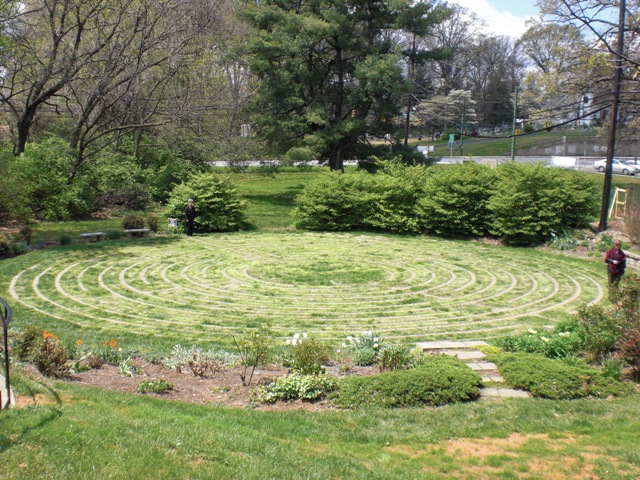
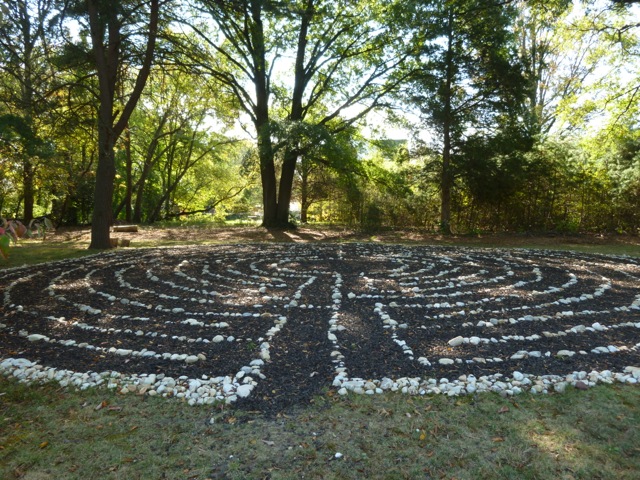
Walking two labyrinths of the same pattern, in similar settings near Washington, DC, provided a great opportunity to compare the little design details that give a labyrinth its individual character. Both the private Hallowood Retreat Center and the public Brookside Gardens sited their labyrinths next to small lakes. Both follow the Santa Rosa design by Dr. Lea Goode-Harris and use similar materials, rough gravel for the path and stone blocks to mark the path's boundaries. 

Labyrinth at Hallowood Retreat Center near Sugarloaf, MD

Click to view larger image.

The two main points of difference are the sense of enclosure and the contrast between the path and its boundaries. 


Enclosure

The Hallowood labyrinth slopes a little more than the Brookside site, toward the water, and is enclosed on the uphill side by a line of shrubs, trees, and large rocks. The waterside vista is toward the retreat center buildings on the other side of the lake. At a labyrinth event that I facilitated at Hallowood, one participant said she felt more enclosed than she expected, given how much of the site is open.  

At Brookside, things are roughly reversed. The lakeside view is toward a large cypress tree and the island that shelters the Japanese tea house and garden.  Away from the lake, the view is up a long hill. 

Contrast

The second major point of difference is the contrast between line and path. The Hallowood labyrinth uses larger blocks to mark the path than the one at Brookside. The roughly 2-to-1 ratio between lines and path gives it a very solid feel, accentuated by the stronger contrast between the dark gravel and lighter blocks. The Brookside labyrinth feels like it's drawn with a pencil, rather than a wide-tip marker, and the path is wider. 

Labyrinth at Brookside Gardens, Wheaton, MD
 Click to view larger image.I rather like the scattering of leftover blocks near the entrance of the Brookside labyrinth. It gives it the suggestion that it's an ancient monument that has seen just a slight bit of decay. 

I'm not saying that one is better than the other, only that these little differences -- and the effect they have on your walk -- are part of what makes it fun to visit outdoor labyrinths.

Saturday
Apr102010

St. Luke's Episcopal Church labyrinth

[UPDATE BELOW] The outdoor labyrinth at St. Luke's Episcopal Church, 6030 Grosvenor Lane, Bethesda, MD, is always available. This is one of many labyrinths in the DC and Baltimore areas supported by grants from the TKF Foundation.


View Larger Map and Directions

Tuesday
Mar302010

Franciscan Monastery catacombs and garden

You don't need to leave Washington to visit the Holy Land. The Franciscan Monastery near Catholic University has been a pilgrimage destination since the early 20th century. You can tour the church (with catacombs) and also visit the replicas of sites from the Holy Land in the monastery garden.

When you come onto the Monastery grounds, take the left-hand walkway look for the sign for "Visitors Entrance." Enter there, and follow the hallway to the left. You will end up in the Tour Lobby. To visit the catacombs, you must join a tour, which will last about an hour. The last tour of the day is at 3 p.m. The monastery requests a donation of $2, which you can place in a box at the end of the tour.

You do not need to join a tour if you just want to look around the church and enjoy the gardens, which include replicas of several Holy Land sites and the Grotto of Lourdes. 

The monastery is located at 1400 Quincy Street, NE, Washington, DC, a ten-minute walk from Brookland/CUA Metro Station. There is a parking lot, as well as on-street parking in the neighborhood.

A map of the monastery church and grounds is available in PDF format by clicking here

  Click to view larger images


View Larger Map and Directions

Tuesday
Mar302010

National Museum of the American Indian grounds

The grounds of the National Museum of the American Indian abound with special places created with sacred intention, including four boulders transported from the four cardinal points of the Western Hemisphere and placed in corresponding positions around the museum. The quiet space pictured below, on the north side of the museum, is adjacent to a pond that has developed its own ecosystem, just a few blocks from the U.S. Capitol. At dusk, you may be lucky enough to see the family of ducklings making their way toward dinner. 

Click to view larger image

Also worth seeing (besides the museum artifacts themselves), the Potomac Rotunda on the ground floor of the museum is frequently used as ceremonial space.


View Larger Map and Directions

Monday
Mar292010

National Japanese American Memorial

One of Washington's least known monuments is the National Japanese American Memorial near Union Station. It includes a water feature in zen garden style and a magnificent monument to all those who struggle against injustice, in the form of two cranes trying to free themselves from barbed wire (photo from http://www.njamf.com).

Closest Metro is Union Station (Red line). The memorial itself is at D Street & New Jersey Avenue, NW, 
Washington, DC 20001. 

 Crane photo from http://www.njamf.com


View Larger Map and Directions